The escalating Haredi crisis in Israel reveals the depth of divisions within society and the ruling coalition.
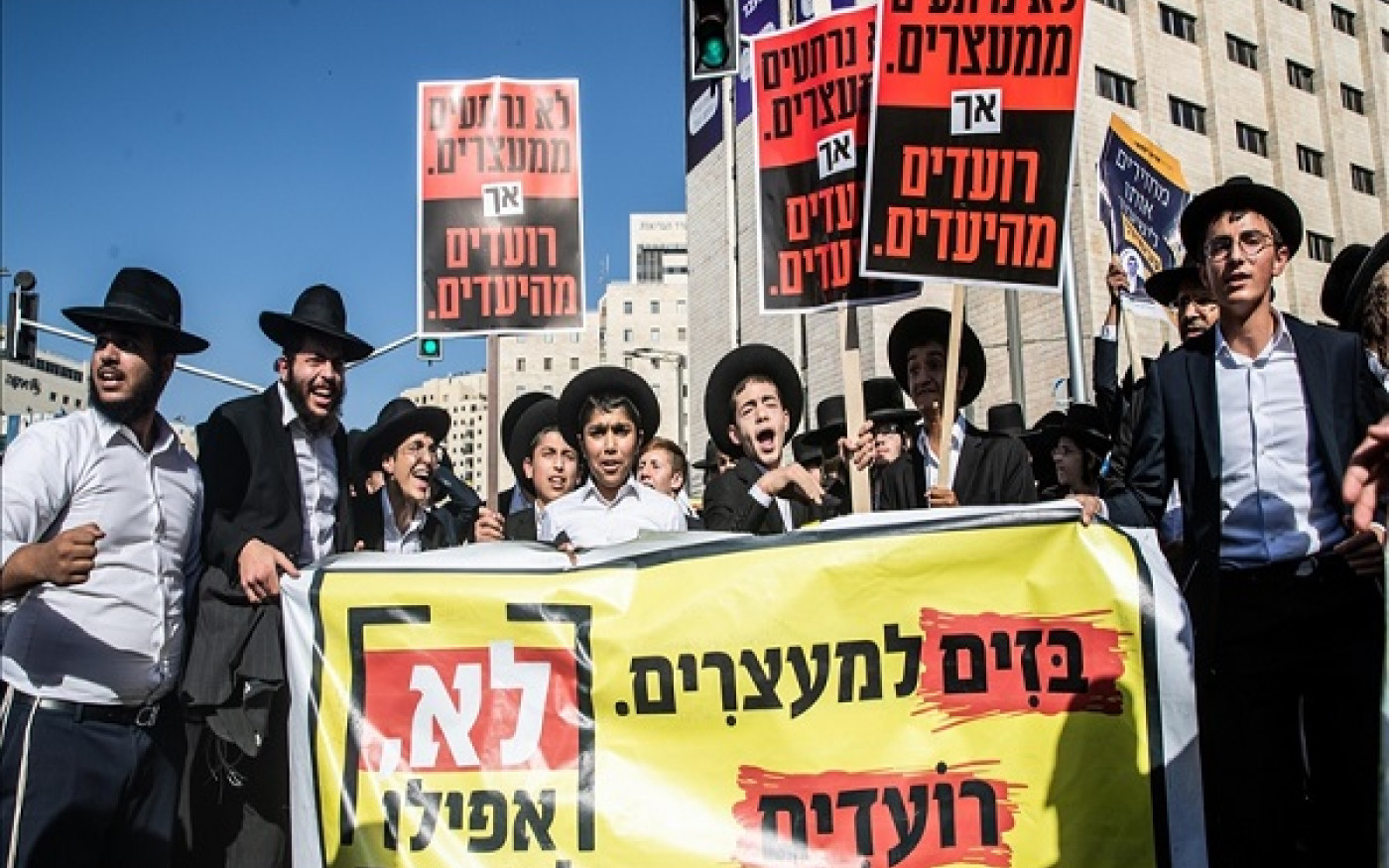
In recent days, Jerusalem witnessed an unprecedented million-strong demonstration organized by thousands of Haredi Jews, protesting the Israeli government's attempts to reinstate mandatory military service for ultra-Orthodox men.
The demonstration escalated into something resembling religious and social defiance, as protesters blocked main streets and raised religious banners affirming their rejection of any infringement upon their faith or their way of life, which is based on isolation from state institutions.
The protest, which included religious figures, yeshiva students, and political leaders from Haredi parties, was considered the largest in many years. It came at a sensitive political and security juncture for Israel, as the conscription crisis coincided with escalating criticism of the army's performance during the recent war on Gaza and a decline in Israelis' trust in the ruling establishment.
The demonstration became a stark illustration of the deep divide between the modern state, which seeks to impose "equal citizenship," and the closed religious community, which views military conscription as incompatible with Jewish law and its spiritual mission of "serving the Torah."
Imad Abu Awad, an expert on Israeli affairs, stated that at the beginning of the state's establishment, the Haredim constituted a small percentage of Israeli society, not exceeding one and a half percent. He added that the state's founder, David Ben-Gurion, could not have anticipated that this issue would one day generate such widespread debate and attention.
Abu Awad pointed out that the Haredim, their demonstrations, and their adoption of this approach clearly demonstrate their unwavering commitment to change, as the issue is deeply rooted in their religious beliefs. Furthermore, they are comfortable with their current situation, effectively absorbing the state's resources and implementing their interpretation of the Torah.
He emphasized that the real gap lies not only between the Haredim and the secular state, but also between the Haredim and all other segments of society. He explained that they have a rift with religious nationalists, such as the Ben-Gvir and Smotrich groups, who advocate for their conscription, as well as with the mainstream religious establishment.
He said that the Haredi lifestyle, particularly regarding military service, the economy, and education, will eventually lead to a structural imbalance within Israel.
He added that the war revealed a shortage of soldiers, but the near future will reveal an economic crisis and an increase in illiteracy rates because their education is limited to the study of the Torah, Hebrew, and arithmetic, and even then, only in a basic way.
He continued, saying that this issue will escalate into conflicts and blackmail because the Haredim have a significant ability to blackmail the state and drain its resources in exchange for their presence in the government. He explained that they do not adhere to a fixed political line but rather side with whoever pays the most, whether from the right or the center.
Abu Awad emphasized that the Haredi behavior will weaken Israel in various aspects—intellectually, economically, and socially—because it creates an inequality in bearing burdens, which pushes some Jews to consider emigrating from Israel.
He pointed out that one of the reasons for emigration is the Haredi lifestyle.
He explained that the anticipated future economic imbalance stems from the fact that this group currently constitutes about 17% of the Jewish population, a figure expected to reach 30% soon. This is because the average family size among them is six children, compared to two or three for the rest of society. This will lead to political and religious conflicts and deep divisions that will affect Israel and its image.
He added that the issue of the Haredim and the elections has a sectarian dimension, as they will receive their usual number of votes (around 17 to 18 seats). He asserted that only Benjamin Netanyahu can grant them immunity regarding military conscription.
He believes this issue will ultimately benefit Netanyahu after the elections, even though it is causing him headaches beforehand, as he promised to pass the conscription law but has yet to do so due to internal opposition within Likud itself.
Regarding Gaza, Abu Awad stated that Netanyahu is adopting a clear strategy based on maintaining the status quo. He explained that a return to a war of annihilation or fighting inside Gaza in the same manner as before is not favored by Israel, not because of any commitment to an agreement, but because it would be costly both domestically and internationally, especially given the conscription crisis. He pointed out that the political arena in Israel has become a competition for the most extreme positions in order to gain the favor of the Israeli public.
For his part, Israeli affairs expert Ismat Mansour said that this demonstration perhaps reflects the peak of fragmentation within Israeli society regarding the state's identity, its constituent parts, and its ability to coexist and continue using outdated mechanisms.
He added that the war revealed the security establishment's need for conscripts, which reignited the issue and demonstrated that the religious parties are entrenched in their positions. This led them to withdraw from the government and protest within the coalition, culminating in this march.
Mansour indicated that the identity of the Israeli state, its institutions, its internal dynamics, and the relationship between its constituent parts have become pressing issues within Israeli society and could erupt into confrontations, especially if the right-wing government continues to rule while simultaneously being unable to impose its will on matters of the judiciary, conscription, relations with the religious community, education, and the media.
He explained that these crises threaten the very fabric of unity, and that the possibility of them escalating into civil war or social unrest remains. He emphasized, however, that the safety valves within Israeli society are still functioning, even though they have begun to erode, weaken, and become increasingly fractured.
Mansour observed that Netanyahu's position at this juncture presents a clear contradiction. On the one hand, he seeks to garner support from the religious community, while on the other, he relies on a religious Zionist base that serves in the army and opposes exempting Haredim from military service, thus creating a dilemma for him.
He concluded that Netanyahu will attempt to focus on other issues while keeping his pledges regarding the conscription crisis vague and general, without any concrete commitment, in an effort to prevent the crisis from erupting within his ruling coalition.