Arab citizens of Israel are the most affected by laws that restrict political representation, civil society, and freedom of expression.
On February 29, 2016, the Knesset's Constitution, Law and Justice Committee approved a proposal that, if passed, would allow for the indefinite suspension of Knesset members by a vote of 90 out of 120. The proposed legislation undoubtedly targets Arab members of the Knesset. Earlier this month, the Knesset Ethics Committee suspended three Arab members for two to four months as punishment for meeting with the families of Palestinians accused of terrorism who were shot dead after killing Israeli civilians. It goes without saying that the Ethics Committee did not suspend Jewish members who made similar visits—for example, Israeli Justice Minister Ayelet Shaked met with the family of the Jewish terrorist accused of burning the Dawabsheh family home last year, but she faced no repercussions for this visit.
This bill is the latest in a series of legislative efforts and policies that constitute a serious infringement on civil and political liberties in the country. While much attention has been paid to the impact of these policies on the Israeli left and Israeli civil society in general, the Palestinian Arab minority has disproportionately borne the brunt of their damaging consequences.
The suspension this month of three Arab members of parliament and the proposal to grant members the power to suspend others indefinitely appear to be further steps in a scheme to increasingly marginalize the Arab minority in Israel and curtail its political representation. In several recent Knesset elections, the Israeli Central Elections Committee has barred certain Arab parties from running. While the committee occasionally disqualifies far-right Jewish parties, this is done under the pretext that their racist agendas undermine Israel’s democratic standing. Efforts to ban Arab lists are based on calls by Arab candidates to transform Israel from a Jewish state into a state for all its citizens. The Supreme Court has repeatedly overturned these rulings, but this has not prevented the growing effort to limit Arab political representation. In a similar move, the Knesset, prior to the 2015 elections, raised the threshold for winning parliamentary seats from 2 to 3.25 percent of the vote in an attempt to block the participation of Arab parties, which are typically quite small. This move backfired, however, as all the Arab parties united in a joint list, becoming the third-largest bloc in the Knesset.
Civil society and freedom of assembly are also contentious issues. In recent years, the Israeli government has taken a series of steps against NGOs, including proposing legislation to revoke tax exemptions enjoyed by some organizations, preventing NGOs from registering for political reasons, requiring prior government approval for receiving donations from foreign donors, and labeling some non-profit organizations as receiving funding from “foreign agents.” These efforts have raised concerns among Israeli civil society, Jewish communities abroad, and foreign diplomats from the European Union and the United States. While the legislative efforts targeting NGOs have been widely condemned, the suppression and marginalization of Arab civil society have gone largely unnoticed, despite being arguably far more serious.
On November 17, 2015, the Israeli security cabinet, headed by Prime Minister Benjamin Netanyahu, declared the northern branch of the Islamic Movement in Israel an illegal organization. The Islamic Movement, an affiliate of the Muslim Brotherhood, has been active in Israel since the 1970s, working over the years in the areas of Islamic outreach, social and community activism, and political activism. While no official figures are available on the number of members of the Islamic Movement, a 2015 poll found that more than 40 percent of Palestinian citizens of Israel support the movement. Efforts to outlaw the Northern Branch began in 1996, when it launched the "Al-Aqsa in Danger" campaign, accusing Israel of planning to alter the status quo at the Temple Mount/Haram al-Sharif in Jerusalem. However, Israeli security officials have repeatedly stated that the movement has no links to terrorism or illegal activity, and that banning it would only push it toward extremism. The ban has far-reaching consequences for hundreds of affiliated NGOs and tens of thousands of activists. Activists can now be arrested simply for being members of the movement, and the assets of affiliated organizations can be confiscated. The security cabinet's decision criminalizes "any party or person belonging to this organization from now on, and anyone who provides it with services or works within its ranks."
The scope of the ban on Arab NGOs is significantly, and blatantly, lower than that imposed on Jewish organizations. When Israeli governments have established legal barriers against Jewish movements in the past, such as the far-right Kach and Kahane Chai movements, they have classified these movements as "terrorist organizations" based on evidence of their involvement in terrorist activities or incitement to terrorism. However, in the case of the northern branch of the Islamic Movement, it was outlawed entirely, even in the absence of any evidence linking it to terrorism.
Even artistic and cultural freedom of expression has come under attack. For example, the “Nakba Law,” passed in 2011, authorizes the Ministry of Finance to cut funding to any public institution, including schools, that commemorates the Nakba, which Palestinians consider a national tragedy. While the law does not explicitly state that Arab institutions and schools are the primary target, it disproportionately burdens them by penalizing expressions of a fundamental component of Palestinian cultural identity.
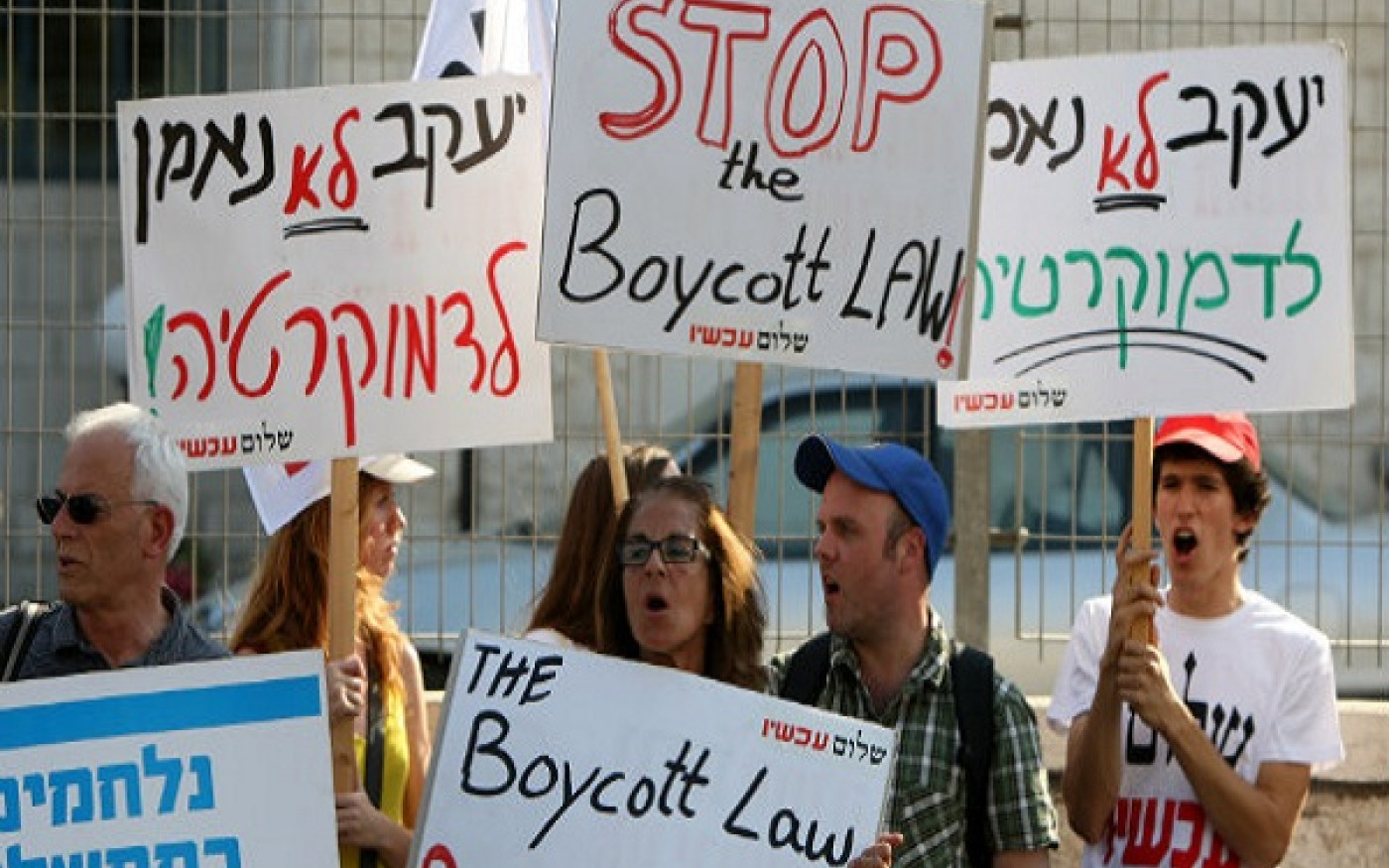
Furthermore, the “Boycott Law,” also passed in 2011, prohibits Israeli citizens and organizations from calling for a boycott of Israel, and even more so, from calling for a boycott of Israeli settlements in the occupied territories. The law exposes boycott supporters to civil lawsuits and threatens state-funded cultural, educational, and scientific institutions with budget cuts and the loss of tax exemptions. Minister of Culture and Sport Miri Regev recently announced that she would introduce a new funding standard that would penalize state-funded cultural institutions that refuse to participate in cultural activities in settlements. She threatened to cut funding to the theater of Palestinian-Israeli actor Norman Issa, who had announced that his company would not perform in settlements. Issa later reversed his decision. Again, while the language of these laws and policies is directed at all Israeli citizens, they primarily affect Arab citizens.
Minister Regev also proposed a “Loyalty in Culture” bill that would withhold funding from cultural institutions that demonstrate “disloyalty” to the state through practices such as commemorating the Nakba, undermining Israel’s Jewish and democratic identity, or inciting terrorism or racism. However, given the large number of Jewish organizations, educators, and politicians who advocate prioritizing Israel’s Jewish character over its democratic character—and given Regev’s own history of inciting racism—the proposal appears to be aimed at Arab citizens and their sympathizers. Israeli Education Minister Naftali Bennett also sought to silence dissenting political voices in the cultural sphere, removing plays and books he deemed inappropriate from the mandatory and elective school curricula. The Al-Midan Theater in Haifa, the only Arab theater in Israel receiving government funding, was a prime victim. Even in cases where the minister appeared not to be specifically targeting Arabs, such as his decision to remove a novel by a Jewish author from the mandatory curriculum, the underlying motive was that the novel depicted a romantic relationship between an Arab man and a Jewish woman.
It can be argued, therefore, that the bills, legislation, policies, and initiatives undertaken by successive Israeli governments under Benjamin Netanyahu collectively constitute a systematic attack on the rights of Palestinian citizens of Israel. The ongoing erosion of the civil and political liberties of 20 percent of Israel’s population continues to undermine the country’s liberal democracy. However, it is highly unlikely that the Arab minority will remain the only group suffering from a shrinking space for expressing its political dissent.
As the government increasingly cracks down on the opposition, some Jewish NGOs have also faced attacks or restrictions (though not as severe as those faced by Arab organizations like the Islamic Movement). Human rights organizations such as B'Tselem, the Public Committee Against Torture in Israel, and HaMoked (the Center for the Defence of the Individual) have been targeted by right-wing organizations affiliated with parties in the ruling coalition. Minister Bennett banned Breaking the Silence, a movement of former IDF soldiers that exposes the moral toll of the occupation, from giving lectures in schools and to soldiers. A group of Knesset members proposed a bill to outlaw the movement. The government's targeting of the civil and political rights of Arab citizens should sound alarm bells, not only because it is attacking a minority of the population, but also because of the implications for the vitality of the democratic opposition in the country.